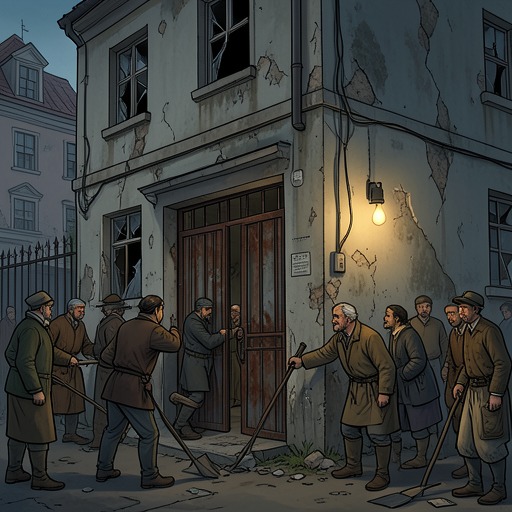
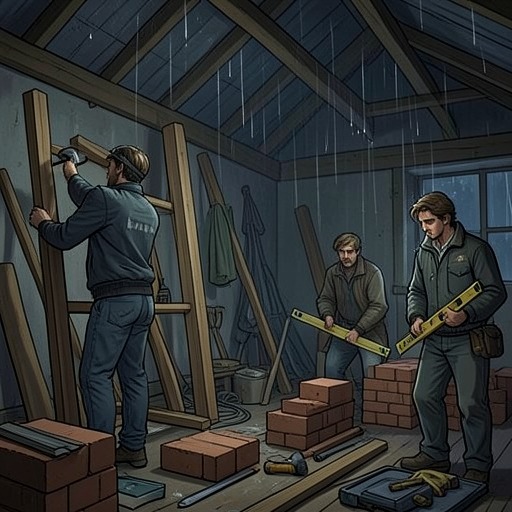
Harbor Street Roof Collapse and Emergency Animal Evacuation
The Wife He Never Wanted: A Marriage-In-Crisis Billionaire Romance (Second Chance Billionaires)Harbor Street Roof Collapse and Emergency Animal Evacuation is the book’s central disaster sequence: a violent storm triggers the failure of a roof already weakened by prolonged deterioration, forcing an urgent evacuation of the animals at Harbor Street Shelter. The event changes the shelter from a difficult but functioning refuge into a ruined, displaced operation, while turning Maddox Caldwell’s previously private act of technical attention into a life-saving intervention. It also brings Paige Templeton and Maddox into practical cooperation before either is ready to call that cooperation forgiveness or reconciliation.
Causes and Background
The collapse is not presented as an unforeseeable act of weather alone. Maddox had noticed the danger during his volunteer shifts at Harbor Street Shelter, after sitting on the concrete floor near Skipper and looking up at the roofline. Above Skipper’s run, the corner sagged; the fascia dipped, and a stain ran down the block where water had been entering for some time. His construction experience allowed him to recognize that the problem had moved beyond cosmetic damage. The roof’s load path was failing slowly, making the storm a trigger for a vulnerability that had already been developing.
Maddox reported the compromised corner to Claire and urged an updated assessment. The warning mattered because it identified a specific structural risk before the building failed, but the shelter lacked the time and funds to complete the necessary follow-up. When Claire later explained the collapse to Paige, she acknowledged that she should have pursued the engineer Maddox recommended. The sequence therefore links disaster to institutional scarcity: Harbor Street’s animals were exposed not because their caretakers ignored them, but because an underfunded shelter operated inside an aging building whose risks exceeded its resources.
The storm supplied the immediate pressure. Straight-line wind warnings and flash-flood watches covered three counties, while rain struck the Templeton house hard enough to rattle its gutters. Paige had spent the evening watching the weather and worrying about the old shelter roof. Claire’s call came at nine on Thursday night, and Paige answered before the second ring because she had already been waiting for bad news. Claire’s first report was stark: the roof had come down.
Collapse and Evacuation
The east runs fell first, specifically the corner Maddox had identified weeks earlier. Part of the intact wing came down with it, and water poured into the main kennel room. Claire faced the immediate task of moving thirty animals within an hour, but emergency boarders and veterinary clinics were full, while flooding had affected much of the county. The shelter did not possess a ready-made alternative; the crisis had to be solved while it was unfolding.
Paige put on her coat, told Claire to crate the animals nearest the water first, and drove toward Harbor Street through rain that overwhelmed the windshield wipers. During the drive, she confronted the fact that Skipper’s former kennel was the section that had collapsed. If Maddox had not adopted Skipper only days earlier, the scarred, unwanted dog would probably still have been in that run and might have died there. Skipper was safe at Maddox’s home, but thirty other animals remained in immediate danger. The contrast gives the evacuation a personal edge without reducing it to Paige’s private feelings: one animal had escaped the failed structure through an earlier act of care, while the remaining population still required rescue.
Two miles from Harbor Street, Paige accepted that she needed Maddox’s help. The decision was deliberately practical. She was not calling the husband who had treated their marriage as a merger, nor was she offering forgiveness. She needed the only person she knew who could provide a roof for thirty animals quickly, and Maddox had an empty, unfinished development with a sound roof. He answered on the first ring. Rather than make her explain the emotional meaning of the call, he told her he would get people moving and meet her after giving the operation thirty minutes to begin.
Harbor Street was already full of water and confusion when Paige arrived. Claire and two volunteers hauled crates through ankle-deep runoff, while the east end stood open to the sky and rain swept across the concrete where a kennel row had been. Paige joined the work immediately. She helped frightened dogs, yowling cats, and whimpering puppies pass through a line of soaked volunteers. She stopped a border collie from escaping through the open wall, carried a senior cat in a pillowcase when the carriers ran out, and held a flashlight in her teeth while Claire coaxed a terrified pit bull from a run near the collapse. Water rose over their boots, and a puppy screamed continuously as Paige carried it.
The evacuation’s intensity leaves no space for staged intimacy. Paige loses track of when Maddox will arrive because the next crate and the next animal consume her attention. The disaster is measured through concrete tasks rather than speeches: animals are lifted, persuaded, restrained, passed hand to hand, and moved away from the water while the storm continues to enter the building.
Emergency Mobilization
Then Caldwell trucks arrived through the storm. Men in rain gear followed a site manager, and Maddox came among them in a jacket that was already soaked through. He did not approach Paige first. He went to Claire, who was directing the evacuation, asked what she needed, and performed those tasks. That choice is important to the event’s moral structure: the response is organized around the shelter’s operational authority and the animals’ needs, not around Maddox’s relationship with Paige.
Paige watched him when she had spare moments. He hauled crates through the rain like every other person on the line, without attracting attention or manufacturing a scene. Twenty minutes later, the unfinished development was open to the animals, with utilities working and heat pushing back the cold. The lobby became a temporary shelter filled with crates, blankets, wet-animal smell, and animals and people trying to recover while rain struck the glass. The empty building, previously a symbol of unfinished commercial space, acquired an immediate social function: it became protection because Maddox made its usable infrastructure available at the moment Harbor Street lost its own.
Near midnight, Paige found Maddox in the half-finished lobby with a shivering terrier mix asleep against his chest inside his ruined jacket. He had been holding the dog before she approached, so the gesture could not plausibly have been arranged for her benefit. The event thus makes his change legible through labor and care rather than declaration. His help arrived as trucks, workers, heat, shelter, and physical effort; it did not arrive as a public performance, a request for praise, or a demand that Paige reinterpret the marriage.
Consequences and Reconstruction
A week later, the animals were safe but homeless, and Harbor Street could not reopen in the old building. The insurance assessment made the disaster’s structural consequences plain. Coverage was partial, and preexisting deterioration in the flagged corner triggered an exclusion that left most of the structural failure uninsured. Code upgrades were also excluded. Reopening would require a modern-code rebuild rather than a simple repair, and the price exceeded what the shelter had ever possessed. Even before the storm, the cramped site had not offered enough capacity; after the collapse, it was a wet ruin carrying a cost no grant could close.
The disaster therefore changes the question from how to repair Harbor Street to whether the institution can be rebuilt on a safer and more adequate foundation. Maddox comes to the Templeton kitchen with a cardboard tube of drawings and a laptop rather than flowers or a conventional romantic gesture. He has reviewed the insurer’s figures and agrees that the old site cannot be rebuilt affordably. His preliminary material includes feasibility sketches, three possible sites, zoning and access notes, flood-plain information, and numbers supporting a construction commitment backed by the Caldwell name.
The most consequential document is not a finished architectural plan. It is a largely blank template titled Program Requirements, with spaces for intake capacity, an isolation ward, quiet rooms, and community space. Maddox tells Paige and Claire that he knows buildings but does not know shelters, so they must specify every room, run, and function the facility has needed but never had room to accomplish. He will provide the money, land, and crew; Paige and Claire will decide what gets built. Claire immediately begins defining a true quarantine wing with separate air handling and an indoor community room large enough for adoption events.
This reconstruction proposal is a direct consequence of the collapse, but it is not merely restoration. The old building failed after years of deterioration and insufficient capacity; the new plan responds by incorporating safer standards, flood-related site information, expanded animal-care functions, and spaces for community work. Maddox’s role also changes. Earlier, his instinct was to control variables and present a finished answer. Here, the blank page gives authority to the people who understand the shelter’s daily operation. The disaster thus produces a transition from emergency coordination to shared reconstruction governance.
Narrative and Thematic Significance
The event joins two kinds of vulnerability. The shelter’s physical weakness has accumulated gradually, while the storm makes that weakness suddenly visible. Maddox can read the roof because of the building knowledge inherited from his grandfather’s world, but he cannot repair his marriage through the same controlling expertise. His recognition of the failing roof becomes useful precisely because he acts on it without trying to possess the people involved. The roof can be assessed, the animals can be moved, and the unfinished development can be opened; Paige’s trust, by contrast, cannot be obtained through a transaction.
The evacuation also gives Paige agency under pressure. She calls Maddox because the animals need a solution, not because the call erases the injury in their marriage. Once at Harbor Street, she works within Claire’s rescue operation, concentrating on individual animals and immediate hazards. Later, when reconstruction begins, she and Claire receive the authority to define the new shelter. The sequence therefore moves from danger, to coordinated care, to a rebuilding process in which the affected institution is not simply managed by a wealthy benefactor.
Most importantly, the collapse makes redemption visible as unobserved labor. Maddox’s assistance cannot be dismissed as a campaign because he works without press, applause, or a carefully engineered moment for Paige. The storm strips his resources of their usual transactional meaning and tests whether they can be used without controlling the recipient. The answer begins in the flooded kennel, continues in the heated unfinished lobby, and reaches its clearest form in the blank program document: he can offer shelter, but he cannot buy back the marriage. He can build the walls, while Paige and Claire retain the right to determine what those walls must hold.